
CONFLICT OF INTEREST POLIY
This process covers steps to be taken to identify and manage an actual or potential conflict of interest.
BACKGROUND
Employees, mandatories, and representatives may be faced by ethical questions on a daily basis. It is easy to make a ‘wrong’ ethical choice when there is no ethical structure in place. It is important for every staff member to identify actual and potential conflicts of interest and manage these according to our internal policy. There is an ongoing obligation to disclose potential, perceived, and actual conflicts of interest during the term of engagement as staff become aware of them.
Actual COI means a set of established circumstances (interests) that detract from the staff member’s fulfilling of their obligation
Potential COI means a set of established circumstances where actual conflict may result if one or more future known events occur.
IDENTIFYING AN ACTUAL OR POTENTIAL CONFLICT OF INTEREST
In examining business relationships and engagements, examine external contractual relationships, partnerships, private companies, or any other commercial trading activity.
In examining close personal affiliations, examine direct relationships with parents, children, and siblings, other financial dependents, spouses, de-facto partners, and any other known close relatives, in-laws, or people with whom a current or recent close relationship could potentially compromise the interests of the FSP or its clients.
The following situations must be avoided:
● Any activity which may be construed as insider trading
● Incentive remuneration for placing a quantity of business with only 1 supplier, or for only 1 product of a supplier where a choice is available
● Incentive remuneration for placing business with any associated party
● Activities that have the potential to affect a staff member’s objectivity
● Activities that could reflect negatively on the reputation of the business and its staff
● Gifts that amount to material benefits;
● Financial interests in excess of the aggregate of R1000 per calendar year;
● Payment or provision of all or part of the costs of any business service or other business expense, including but not limited to:
– Office rental;
– Computer hardware and commercial software;
– Provision of staff or payment of all or part of staff salaries
● Receiving or soliciting outside employment or compensation, including paid service on a governance board, that would impair the independence of judgment of the individual in performing their duties
● Participating in any activity that might lead to or give the appearance of unapproved disclosure of the business’ or any client’s confidential information
● Using an official position to obtain special privileges or advantages from individuals or businesses
The following situations must be disclosed:
● Where the FSP or some other person connected with us has an interest, relationship or arrangement that is material to the service, or transaction concerned with any client. This includes directorships, key individual appointments, and shareholding arrangements
● Referral fee arrangements
● Where the FSP has a 10% or more shareholding in any product supplier
● Where more than 30% of income is derived from any product provider
● Domestic educational or professional development conferences that are awarded to the provider using selection criteria that are not based on sales volumes, including any part payment towards the costs. This does not include travel and accommodation expenses, which may not be accepted.
The following does not have to be disclosed:
Computer software linked to a product supplier’s products, such as a product-linked advice tool.
DECISION PROCESS
The above lists are not exhaustive, and it is the responsibility of every staff member to be able to identify an actual or potential conflict of interest which may arise. Principles and moral judgement must be used to assess each situation. Consider contextual features of the case that seem important such as the past history of relationships with various parties.
MORAL MODELS
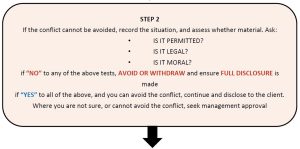
It is important to think about what a person of moral integrity would do. Establish whether the proposed action or situation is:
● Legal
● Permitted in terms of company policy
● The right thing to do
Should any of the above questions be “no”, then do not continue, document the situation and the decision to not proceed, and ensure this is provided to management. Management will determine further course of action.
PROPOSE AND TEST POSSIBLE RESOLUTIONS
Consider the following critically:
● which factors would have to change to get you to alter your decision?
● Think about the effect of each choice upon the choices of other responsible parties.
● Are you making it easier or harder for them to do the right thing?
● Are you setting a good example?
● Would a good person do this?
● Ask yourself what would a professional with integrity and experience – do in these circumstances?
● Will this maintain trust relationships with others?
● If others are in your care or otherwise dependent on you, it is important that you continue to deserve their trust.
● Does it still seem right?
● Are you still satisfied with your choice?
PERSONAL JUDGEMENTS
Colleagues and management input and advice can be invaluable. In discussions, it is critical to respect client and employer confidentiality. Discussion with others is particularly important when other decision-makers are involved.
AVOID THE SITUATION
If you can avoid the situation, make full disclosure to the client on the conflict of interest form before you transact with the client, and proceed. Ensure you provide copies to management.
Where cannot avoid the situation, but you believe that you can continue with the action, after going through the above process, request management approval.
MANAGEMENT APPROVAL
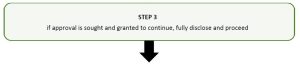
Where management approves the situation, continue, and make full disclosure to clients before any transactions happen.
Where management does not approve, do not proceed, and ensure that all documentation relating to the situation is provided to management.


We are required to keep clear records of any conflict of interest or potential conflict of interest transactions and how we attempted to avoid or mitigate where avoidance is not possible, the impact. A conflict of interest disclosure form must be completed for every situation where an actual or potential conflict occurs, and this must include the measures taken to avoid or mitigate any conflict. The customer must be fully aware of all potential conflicts before he makes a decision in respect of the financial products we sell him, and we need to be able to prove this.
If the conflict of interest has been identified, and it could impact on your objectivity with a client, indicate how this may be avoided.

DISCLOSING CONFLICTS OF INTEREST
Explain the situation to the client and how the conflict of interest can be managed, or how it will be avoided. State the possible options at each stage of decision-making as well as the likely consequences of various decisions. Take into account good or bad consequences for all affected persons.
The client must confirm in writing that they are in agreement with the solution and that they are in a position to allow the transaction, activity, etc to proceed
The form is to be signed by the customer to acknowledge that the disclosure has taken place and that he has been notified of the potential conflict of interest situation. All measures to avoid or mitigate the conflict must also be recorded.
Copies of the form:
1. Make a copy of the Form for your records.
2. Forward a copy of the form to the responsible person and ensure that your copy has been signed as proof of receipt.
3. Provide the client with a copy of the form and ensure you get written confirmation of receipt
GIFTS AND ENTERTAINMENT
Where any staff member is presented with a gift, gratuity, entertainment, or other incentive from any product supplier or other financial services provider (“gift”) or associate:
● Management approval must be obtained to accept the gift before it may be accepted
● The details of the gift must be entered into the gifts register
● If the running total of the gifts received by a representative is R1 000 or more, in any calendar year, no further gifts may be accepted. These must be returned to the donor. The recipient may not give the gift to any other person instead of returning it.
● All staff must be notified in writing once their gifting limit is reached for the year.
REFERRAL FEES AND COMMISSIONS
Where any referral fees are anticipated being paid or received, the following process must be followed:
● Management must approve any referral fee arrangement before implementation
● A referral fee agreement must be signed by both parties and placed on file
● The details of the referral must be added to the Conflicts of interest and referrals register
● A full audit trail of all payments to or from, as well as details of the business which has resulted from such referrals, must be kept.
● The FSP must disclose to every client who has been referred, the details of the referral agreement, including details of all remuneration either paid or received for this business.
CONFLICT OF INTEREST CHAMPION
This is the person responsible for overseeing the management of the business’ Conflict of Interest policy and as such responsible for remaining updated and informed.
It is your responsibility to follow the written procedure manual in respect of managing conflict of interest. It is your responsibility to annually update the policy.
You are responsible for ensuring proper recordkeeping and ensuring that a conflict of interest disclosure form is completed where appropriate, disclosed to the relevant parties, and kept on record
You are responsible for forwarding all reports to the managing body in the first week of every month for further action
Treat all your records about this matter as confidential. Sharing information should be on a “need to know basis”.
WHEN RECEIVING A COI FORM
Ensure that you countersign the form and provide the staff member with a copy for their records, to acknowledge receipt.
Review the Form before any decisions are made. Note any additional information you receive or elaborations as you will be considering this information as you address the conflicts of interest
Identify whether the COI will be material or not. Refer to the business’ policy manual for dealing with either material conflict of interest situation(s) or lesser COI situations
Develop a strategy to address the reported conflicts
Make the final determination for addressing these reported conflicts. Consult with others if necessary. Where written consent is required to continue with a transaction, provide written permission to proceed if appropriate.
Provide written confirmation that the reported conflict of interest has been addressed and forward to the managing body in the reporting framework.
RECORDKEEPING
Keep all Forms and written communication (e.g., email, letters, your notes to file involving you and the Investigator or you and others) for no less than five years